
We get it. You walk down the pharmacy aisle, spot a box of whitening strips, and think — why not? They’re convenient, they’re familiar, and they promise a brighter smile in just a few weeks. We’ve all been there.
But if you’ve ever used strips and felt a little underwhelmed by the results — or frustrated that they faded faster than expected — you’re not imagining things. There’s a real difference between whitening strips and professional teeth whitening, and once you understand what’s actually happening in each case, the choice becomes pretty clear.
Let’s Talk About What Strips Actually Do
Whitening strips work by placing a thin layer of hydrogen peroxide gel against your teeth. Simple enough. But here’s the problem: they’re designed to fit a generic mouth, not yours. That means uneven contact, missed spots (hello, spaces between teeth), and a gel concentration that’s been carefully limited for over-the-counter safety.
Add to that the slipping, the extra saliva your mouth produces trying to deal with a foreign object, and the fact that most strips can only sit on the front few teeth — and you start to see why results can be patchy at best.
They work, a little. But “a little” isn’t what most people are hoping for.
What Professional Whitening Actually Looks Like
Professional whitening done at a dental office is a completely different experience — and a completely different outcome.
Before anything even starts, your dentist takes a look at your teeth — checking for existing sensitivities, any underlying issues, and what kind of discoloration you’re dealing with. Because not all stains are the same. Surface stains from coffee and wine respond differently than deeper, intrinsic discoloration. Professional whitening accounts for that.
Then comes the actual treatment: a professional-grade whitening agent (often significantly stronger than what’s in any OTC product) applied with precision, sometimes activated with a special light or laser to enhance the process. Custom-fitted trays ensure the gel stays exactly where it should — coating every surface evenly, edge to edge.
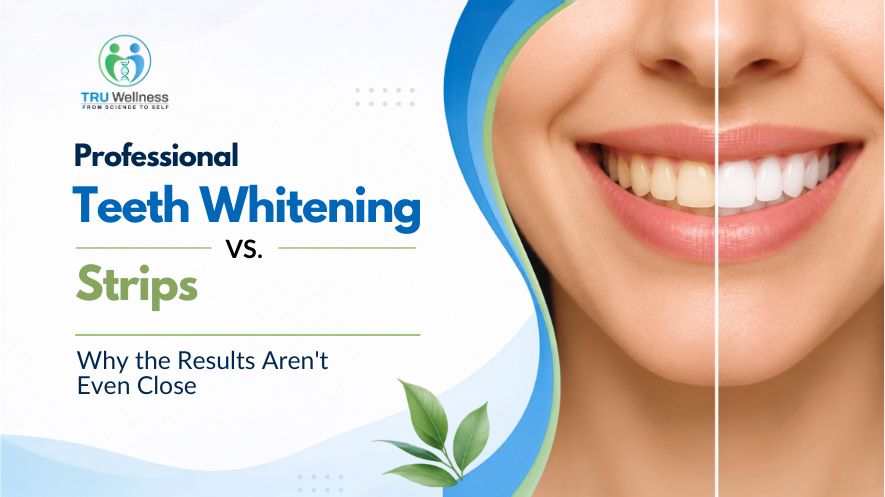
The results? Often multiple shades brighter — in a single visit.
The Sensitivity Question
One of the most common concerns people have about whitening — professional or otherwise — is sensitivity. And it’s a fair one.
Ironically, strips can actually cause more sensitivity problems for some people, because they don’t fit perfectly and the gel can seep onto the gums. Professional treatments include protective barriers for your gum tissue, and your dentist can adjust the formula or application time based on how your teeth respond. It’s a much more controlled, personalized process.
How Long Do Results Last?
Here’s where the gap really shows up. Whitening strips typically offer results that fade within a few weeks to a couple of months — especially if you’re a coffee drinker, tea lover, or red wine enthusiast (no judgment).
Professional whitening, on the other hand, can last anywhere from one to three years with basic maintenance. Many dental offices also send patients home with custom trays and touch-up gel, so you can maintain that brightness in between visits without starting from scratch.
A Few Things Worth Knowing Before You Whiten
Whether you go professional or give strips another try, keep these in mind:
- Whitening doesn’t work on crowns, veneers, or fillings — only on natural tooth enamel. Your dentist can help you navigate this.
- Deeper stains from antibiotics (like tetracycline) or fluorosis may not respond to standard whitening alone. A professional consultation can point you toward the right solution.
- Timing matters. Whitening before any dental work is usually recommended, so your restorations can be matched to your new shade.
- Sensitivity is temporary in most cases. A desensitizing toothpaste before and after treatment can help.
The Bottom Line
Strips aren’t the enemy. They’re fine for minor maintenance or a quick refresh before an event. But if you’re looking for a noticeable, lasting change — the kind of brightness that actually shows up in photos and makes you want to smile more — professional whitening isn’t just better. It’s in a different category entirely.
If you’ve been curious about what professional whitening could do for your smile, it’s worth having a conversation with your dentist. You might be surprised how straightforward — and satisfying — the process actually is.