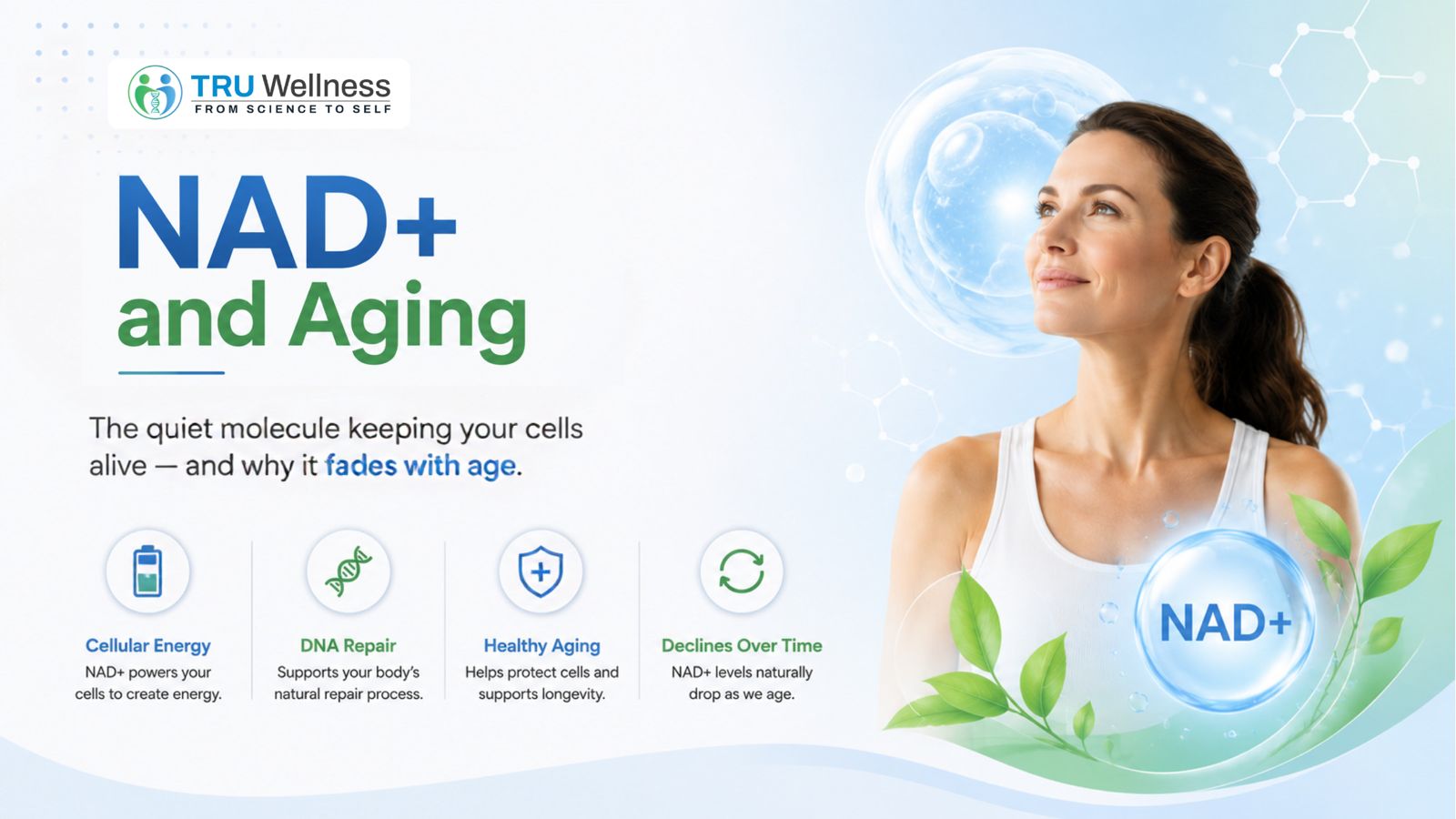

You can’t see it, feel it, or taste it. But deep inside every living cell in your body, a molecule called NAD+ is working around the clock — patching damaged DNA, fueling energy pathways, and telling your cells whether to repair themselves or quietly give up. And somewhere in your mid-thirties, it starts disappearing.
Scientists have known about NAD+ — nicotinamide adenine dinucleotide — for over a century. But only in the last decade have researchers begun to understand just how central it is to aging, and what happens when levels fall.
What exactly is NAD+?
Think of NAD+ as a molecular currency that your cells spend to get work done. It shuttles electrons between chemical reactions, enabling the mitochondria — your cells’ power plants — to generate energy. Without it, the lights go out.
But NAD+ does more than fuel metabolism. It activates a family of proteins called sirtuins, which regulate inflammation, stress response, and genome stability. It also powers PARP enzymes, which are the primary repair crew your DNA calls on after damage. When NAD+ drops, both processes slow. The repair crew gets underfunded. Inflammation creeps up. Energy production sputters.
Why it matters
By the time most people reach 50, their NAD+ levels are roughly half what they were at 20. Some studies suggest the decline begins as early as the mid-thirties — long before most people notice any slowdown.
The aging connection
The link between NAD+ and aging isn’t just correlational — it’s mechanistic. As cells accumulate DNA damage over time (from sunlight, stress, environmental toxins, or simply normal metabolism), PARP enzymes are continuously activated to patch the breaks. Every repair job consumes NAD+. Eventually, the demand outpaces supply.
“The more damage your cells accumulate, the more NAD+ your repair machinery burns through — and the less is left for everything else.”
Reduced NAD+ means exhausted mitochondria, impaired DNA maintenance, and dysregulated sirtuins. The result reads like a checklist of aging: fatigue, cognitive decline, metabolic slowdown, and increased vulnerability to age-related disease. In animal studies, restoring NAD+ has reversed aspects of vascular aging, improved muscle function, and extended healthy lifespan in mice — though translating that to humans remains an active area of research.
Can you restore it?
This is where cellular repair therapy comes in. Researchers have identified two NAD+ precursors — NMN (nicotinamide mononucleotide) and NR (nicotinamide riboside) — that the body can convert into NAD+. Unlike NAD+ itself, which can’t easily cross cell membranes, these precursors slip in and replenish the supply from the inside.
NMN · Nicotinamide Riboside · Sirtuins · PARP Enzymes · Mitochondria
Human clinical trials — still early-stage, but promising — have shown that NMN and NR supplementation can meaningfully raise blood NAD+ levels. A 2021 trial found that NMN improved muscle insulin sensitivity in older adults. Others have reported improvements in energy and sleep quality. The research is encouraging, but scientists are careful to note that higher NAD+ doesn’t automatically mean slower aging — the relationship is nuanced, and long-term human data is still accumulating.
The honest picture
NAD+ therapy is not a fountain of youth, and anyone selling it as one deserves skepticism. What the science does suggest is that maintaining adequate NAD+ levels is important for cellular health — particularly as we age — and that targeted precursor supplementation is a plausible way to support that. The biology is real; the hype often isn’t.
The more reliable approach, at least for now, combines supplementation with habits that naturally support NAD+ production: regular aerobic exercise, intermittent fasting, and limiting alcohol (which rapidly depletes NAD+ in the liver). These aren’t glamorous interventions, but the evidence behind them is deep and consistent.
A molecule worth watching
We are early in the story of NAD+. Major research institutions — from Harvard to the National Institutes of Health — are funding large trials to understand its role in neurodegenerative diseases, metabolic disorders, and cardiovascular aging. The molecule that quietly powered your cells since before you were born may turn out to be one of the most important targets in longevity medicine.
For now, the science says: keep your cells fueled, your DNA repaired, and your mitochondria running. NAD+ is at the center of all three.
References
- Yoshino, M., Yoshino, J., Kayser, B. D., et al. (2021). Nicotinamide mononucleotide increases muscle insulin sensitivity in prediabetic women. Science, 372(6547), 1224–1229. https://pubmed.ncbi.nlm.nih.gov/33888596/
- Covarrubias, A. J., Perrone, R., Grozio, A., & Verdin, E. (2021). NAD+ metabolism and its roles in cellular processes during ageing. Nature Reviews Molecular Cell Biology, 22, 119–141. https://pmc.ncbi.nlm.nih.gov/articles/PMC7963035/
- Yang, Y., et al. (2026). NAD+ supplementation for anti-aging and wellness: A PRISMA-guided systematic review of preclinical and clinical evidence. Ageing Research Reviews. https://www.sciencedirect.com/science/article/pii/S1568163726000498
- Igarashi, M., Nakagawa-Nagahama, Y., Miura, M., et al. (2022). Chronic nicotinamide mononucleotide supplementation elevates blood nicotinamide adenine dinucleotide levels and alters muscle function in healthy older men. NPJ Aging. https://pmc.ncbi.nlm.nih.gov/articles/PMC10692436/
- Yeung, J. et al. Anti-aging compound that improves metabolic health in mice improves muscle glucose metabolism in people. WashU Medicine News. https://medicine.washu.edu/news/anti-aging-compound-that-improves-metabolic-health-in-mice-improves-muscle-glucose-metabolism-in-people/
Note: This content is for general educational purposes and is not a substitute for individualized medical advice. NAD+ precursor supplements are not FDA-approved to treat or prevent any disease.